Sunday, February 4, 2024

Western Civ. 1-135: The Medieval Contribution to Western Prosperity

Prompt:

(1) How can we account for Western Europe's sustained economic success?

(2) Why was the rise of the medieval towns significant?

Introduction:

For the whole of human history until about 1800 all mankind existed in a state of absolute poverty. Remarkably, the former backwater of Western Europe was the first region to experience a sustained period of compounding capital growth and diminishing scarcity. This was a pivotal period in history that altered the economic landscape of our civilization, setting the stage for sustained and growing prosperity and even liberty. Examining the factors contributing to this unprecedented development are crucial for understanding sustained economic success and mankind’s apparent escape from the Malthusian trap. This essay serves as an exploration into the unique factors that paved the way for prosperity. First, by analyzing how we can account for Western Europe's unique and sustained economic success. Then it is also important to explain how the rise of towns had significance not only to economic factors, but also with respect to the political and legal developments that accompanied their improvement. 

Thesis: The Medieval Contribution to Western Prosperity:

The central premise guiding this exploration is the now current historical consensus that the medieval period holds the key to understanding Western Europe's enduring economic success. Contrary to the demeaning modernist rhetoric of Renaissance humanists and Enlightenment philosophes, the high and late Middle Ages witnessed a stark departure from earlier conditions with the unique development of factors basic to the modern paradigm. This was marked by a series of key and transformative contributions to civilization over a period of 800 years. The changes involve improvements in capital, but we find these technologies are not the supreme paradigm in human development. Rather, the new and increasing scope of liberties afforded to private enterprise, was far more basic than capital itself in accounting for the process of development as such, the key topic in this study of economic history. Yet, all of these developments and their compounding effects were only first made possible by the political decentralization of medieval Western feudalism. However, the rise of medieval towns in this politically decentralized context (after the classical collapse) was the medium and key effector of institutional and political changes responsible for the liberty to make contributions that have made possible our phenomenon. In short, the essay is dedicated to accounting for the specific and fundamental contributing factors basic to Western Europe’s economic success, but confined to those that contextually emerged in its period of study. It emphasizes the role of political decentralization in facilitating this civilizational metamorphosis, but holds this context was mediated by the rise of towns. As they developed, they were both witness to economic developments and the key contributors to many flowering liberties that made the former possible. 

An included section must explain why the industrial revolution only occurred when it did, after the end of the medieval period, and not directly as the result of properly medieval developments. It must also detail why political decentralization was and is fundamental according to a certain definition despite the apparent change of conditions before, during, and after the industrial revolution. It basically holds that the phenomenon itself could not have begun if the factors discussed, almost necessarily spawned in this context, did not first proliferate themselves in society.

To conclude, The essay should analyze the current and evolving neoliberal paradigm with respect to its ability for compounding, supporting, and sustaining this basically good phenomenon. 


In The Beginning:

  1. Human History in Absolute Poverty

    • Discuss the historical context of human poverty until about 1800.

    • Emphasize that Western Europe, once a backwater, experienced a unique period of sustained capital growth and diminishing scarcity.

  2. Pivotal Period in History

    • Highlight the significance of the pivotal period in Western Europe's history.

    • Set the stage for sustained prosperity and liberty.

    • Stress the importance of examining factors contributing to this unprecedented development.

  3. The Medieval Contribution to Western Prosperity

    • Present the central premise that the medieval period holds the key to understanding Western Europe's enduring economic success.

    • Challenge demeaning modernist rhetoric and emphasize the departure from earlier conditions.

    • Identify the unique contributions of the high and late Middle Ages to the modern paradigm over 800 years.

List of Contributing Linear Factors:

a. Private Enterprise: 4. Role in Making the Modern World

  • Emphasize the relative freedom given to businesses and entrepreneurs.

  • Discuss the absence of heavy taxation and arbitrary seizures, fostering an environment of business freedom.

  • Explore David Landes' perspective on private enterprise as a unique and crucial factor.

b. Capital and Institutional Factors: 5. Sophistication of Major Industries

  • Highlight the sophistication of medieval industries, including silk, textiles, and consumer goods.

  • Explore the pioneering role of 13th-century Italians in private banking.

  • Discuss the development of insurance associations by guilds, covering aspects like old age, fire, and shipwrecks.

c. Political Decentralization: 6. Crucial Role in Economic Success

  • Elaborate on the concept of political decentralization and its role in Western Europe's economic success.

  • Discuss the significance of competing jurisdictions preventing an all-encompassing empire.

  • Highlight the impact of representative bodies like the English parliament in limiting arbitrary rule and taxation.

The Rise of Towns:

Towns as Magnets for Freedom: 7. Contributions to Economic and Political Significance

  • Discuss how towns became magnets for those fleeing serfdom, contributing to economic and political significance.

  • Explore the unique form of economic and political organization represented by medieval towns.

  • Emphasize the role of towns in offering liberties, both political and economic, to their inhabitants.

Negotiating Liberties: 8. Rights, Charters, and Self-Governance

  • Describe how towns negotiated for rights against lords seeking tax revenues.

  • Highlight the various liberties sought, especially in securing charters for self-governance.

  • Explain the importance of these charters in laying the foundation for modern city councils.

Collective Liberty of Towns: 9. Socio-Economic Magnetism

  • Elaborate on the concept of collective liberty enjoyed by towns as a whole.

  • Contrast with the modern idea of individual rights, emphasizing towns' role in self-governance.

  • Discuss the socio-economic magnetism of towns and their critical role in Western liberty development.

Why was the rise of medieval towns significant?

How the Rise of Towns Shaped Western Liberty and Civilization: 10. Overview of Robert Nisbet's Work - Provide an overview of "The Quest for Community" by Robert Nisbet. - Discuss Nisbet's exploration of the role of communities in shaping societies. - Emphasize the connection between strong local communities and the development of liberty.

Some Study of Western Urbanism: 11. Differences in Societal Structures - Explore the concept of western urbanism and its distinctions from other societal structures. - Discuss the importance of urban centers in acting as hubs for economic and political activities. - Consider the role of cities and communes in conferring political rights and autonomy to citizens.

What the Rise of Renewed Urbanism Had to Do with This Political and Economic Success: 12. Positive Feedback Loop for Development - Explain how the rise of towns created a positive feedback loop for development. - Discuss the role of towns as magnets for those fleeing serfdom, becoming economic and political entities. - Analyze the impact of urban liberties on the overall development of Western Europe.

Political Fragmentation: 13. Views on Political Fragmentation - Discuss the unpopular view of political fragmentation today, contrasting it with Goethe's perspective. - Explore how political rivalry and the right of exit fueled competition among small political units. - Highlight Goethe's emphasis on the benefits of fragmentation as a strong brake on arbitrary behavior.

Importance of Cities and Communes: 14. Emancipation of Serfs and Political Rights - Investigate the emancipation of serfs linked to the existence of cities. - Provide examples of how cities conferred political rights on their citizens. - Discuss the role of cities in limiting the power of governments and enabling the flourishing of private enterprise.

The Rise of Towns in Economic Development:

Economic Impact of Towns: 15. Functions in Facilitating Trade and Commerce - Explore the economic functions of towns, including their role in facilitating trade and commerce. - Discuss how towns became centers for various industries, contributing to economic growth. - Examine the guild system within towns and its impact on trade, regulation, and social welfare.

Natural Power and Large-Scale Industries: 16. Use of Natural Power and Development of Industries - Highlight the early use of natural power in medieval industries, such as wind and water mills. - Discuss the development of large-scale industries in silk, textiles, and consumer goods. - Explore the emergence of primitive factories and subcontracting systems in medieval economic structures.

Banking and Insurance: 17. Development of Banking and Credit Services - Explore the development of banking and credit services in 13th-century Italy. - Discuss the institution of insurance by guilds, covering various risks faced by their members. - Examine the role of guilds in providing insurance products related to old age, fire, shipwreck, and more.

The Medieval Contribution to Western Prosperity:

Political Decentralization as a Key Factor: 18. Reiteration of Importance in Western Europe's Prosperity - Reiterate the importance of political decentralization in Western Europe's prosperity. - Discuss how competition among political units constrained rulers and contributed to economic policy conducive to liberty. - Highlight the demonstration effect, where towns with freer markets became wealthier and more powerful, inspiring emulation.

City Influence and Cultural Development: 19. Goethe's Perspective on Political Particularism - Explore Goethe's perspective on the relationship between Germany's political particularism and culture. - Emphasize Goethe's opposition to political centralization and its perceived threat to liberty. - Discuss Goethe's insights on the impact of various German cities on culture and prosperity, highlighting the importance of princely residences.

Current Relevance of Goethe's Insights: 20. Reflection on Contemporary Relevance - Reflect on the contemporary relevance of Goethe's views, especially in the context of the European Union. - Discuss how Goethe's observations on unity without a large capital city resonate with the benefits of the single EU market. - Emphasize the importance of recognizing the genius of the people and the potential drawbacks of bureaucratic centralization.

Sunday, January 28, 2024

Western Lit. 2-10: More's Utopia

Q: "Why does More present the traveler as a sensible reformer early in Book I, but not later?"


Utopia is an imagined, idealized society often portrayed in literature, where everything is perfect and harmonious. Linguistically, it is a play on the greek words for "good place" and "no place". It first appears in the west as the name of a nation in the first fictional utopian satire. Written by the venerable Sir Thomas More and originally penned in Latin, wasn't intended for mass consumption but literate elites. Despite claims to the contrary, it is intended as a haughty work of satire, not an actual revolutionary document. Published in 1516, with Luther's 95 theses a year later, it emerged during a tumultuous period of intellectual and religious upheaval. Its narritive unfolds through the voice of Raphael Hythloday, a skeptical and learned world traveler whose name happens to mean 'talking nonsense.' Book I is known by Hytholoday's sweeping critique of English society meets with disdain for issues like the nobility, the capital punishment of theft, the eagerness of kings to wage wars, and private property itself. The fictional island of Utopia, with its communal living, absence of private property, and egalitarian democracy, serves as an idealized contrast. Throughout, Hythloday advocates for state intervention to eliminate these afflictions, proposing radical reforms to the existing order. 

While the traveler is initially presented as a sensible, albeit critical reformer and potential courtier in Book I, we soon come to see absurdities and imposible claims made about the country of Utopia, models seemingly offered as unironic solutions to the former social ills. This may lead the reader, and often has, to ask why his credulity was nessesary at all, or if the author intended his magnificent fiction to be taken more seriously than he could openly admit. But the heart of the satire is revealed in More's subtle commentary on the impracticality of radical idealism. By presenting the traveler as a humanist critic initially, More sets up a contrast that highlights the absurdity of the traveler's later, idealistc proposals. This satirical approach prompts readers to question the viability of utopian visions and to consider the complexities of implementing such radical changes. Ultimately, More uses this transition to satirize extreme philosophical propositions and advocate for a more pragmatic and nuanced approach to societal improvement. 

At the end of the first book, we enter a debate that marks a deeper engagement with the philosophical and political traditions of Plato and Aristotle, almost directly quoting their ancient debate. Through dialectical exploration, More invites readers to critically reflect on the tension between utopian ideals and the pragmatic challenges of real-world governance. Then its narrative structure seamlessly shifts between critique and idealism, creating a coherent and engaging dialogue that underscores the complexities of political philosophy. This difference also reflects the contemporary, even internal tension of More between the sometimes radical Renaissance Humanism of the day and the grounded Piety of his Catholic faith and political prominence in the English State. Through authentic and genuine discourse, More's "Utopia" continues to resonate as a timeless exploration of societal transformation and the pursuit of elusive political ideals.


Book I of "Utopia" introduces Raphael, a seasoned world traveler, former nobleman, and companion of Vespucci to the new world. Presented before a group including Sir Thomas More, Raphael assumes the role of a storyteller, sharing his experiences of a marvelous world scarcely witnessed by others. Despite his extensive travels, Raphael asserts himself as a philosopher rather than a mere seaman, aligning with the Platonic ideal of a philosopher king, or perhaps the Renaissance man. His critique of English society unfolds with a particular disdain for nobles and standing armies, attributing numerous societal ills to selfishness, materialism and economic injustice. Raphael extends aversion to enclosed sheep ranches, the free market, taverns, and more, condemning them all as afflictions requiring state intervention. He proposes radical reforms, envisioning a society without any of these perceived vices, by law.

Raphael's detailed critique intensifies as he addresses issues of poverty, crime, and punishment. He challenges the conventional approach to justice, advocating for systemic changes to prevent theft by addressing its root causes. Rejecting capital punishment, he argues for restitution and proposes convicts be employed by the state, asserting the oppertunity to work for the public can eliminate their criminal tendencies. However, his proposals take a dark turn as he suggests segregating and marking convicts, and that providing them with money or arms would be equivlent to a capital crime against the State. The narrative underscores the satirical nature of Raphael's utopian ideals, inviting readers to question the feasibility and ethics of his propositions.

The dialogue shifts to a Cardinal, who endorses Raphael's ideas for dealing with vagabonds. Then, a Jester extends this proposal to friars, emphasizing the widespread implications of these new ideas. Still, the scenario descends into absurdity, illustrating the potential chaos that seemingly agreeable ideas can unleash. Raphael announces his disillusionment with advising kings or court reforms due to their inherent corruption, criticizing ministers for favoring war, high taxes, and tyranny. He also in a strikingly modern way identifies class conflict and cynically urges rulers to prioritize the welfare of the masses over imperialistic pursuits.

The debate on reform strategies emerges, with the choice between gradual reforms and radical change. Raphael places the blame for societal evils squarely on private property, advocating for its abolition as the key and sole hope for transformation. The narrator, likely representing More's perspective, counters by asserting the need for incentives in the real world. The tension between utopian ideals and practical realities becomes evident as Raphael insists that Utopia operates differently, free from the economic incentives that characterize other societies. This sets the stage for a profound exploration of political philosophy, where the clash between idealism and pragmatism drives the narrative forward. 


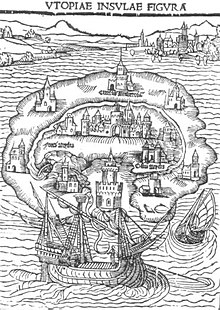
Book II of "Utopia" marks a distinct departure from the critical analysis of contemporary society found in Book I, shifting its focus to visually construct the idealized world envisioned by the traveler, Raphael. The satire in this section becomes evident as the narrative presents a society with seemingly impossible and absurd characteristics, prompting readers to question the feasibility and nobility of such utopian ideals.

Raphael begins by describing the country, a union of 54 cities forming an island. A notable feature of Utopian society is the absence of warfare between cities, a response, it seems, to Raphael's observations of civil wars in Europe. The only reason for this peace, it seems, are the annual councils of the city magistrates. The magistrates in Utopia seemingly possess omniscience over their dominion, meticulously orchestrating every aspect of society. It also seems that the key feature of Utopian society is the active participation of every individual in various occupations, with a regular rotation between them. This utopian vision challenges conventional notions of private property, relying on centralized planning and surplus sharing. Interestingly, it directly addresses the economic calculation problem often posed against socialism. The political system ensures widespread participation, resembling direct democratic rule, portraying a vision of collective diligence and equality. The narritive strikes uncanny similarities between Utopia's ideals and later revolutionary writings, most prominently those of Karl Marx and Friedrich Engels.

In Utopia, there is a near total absence of slackers or lazy individuals, and the workday is limited to a mere six hours, showcasing the society's unthinkably high productivity. Clothing is simple, devoid of all fashion, and highly inexpensive. The mysterious people of Utopia are depicted as unilaterally content and totally devoid of greed. Family size is regulated by law, with excess children redistributed among families. Cities are restricted in size, reflecting the philosophical belief that order and democracy face challenges in larger cities and highlighting the almost fanatic devotion of the nation to that ideal.

The mention of slaves only comes later in our selection. These are described performing menial tasks like animal slaughter and laundry, and their depiction echoes both Athenian society from the 5th century BC and later utopian experiments. Meals are communal, aligning with Plato's principles and practices in societies like Sparta and the Soviet Union. Their concept of the family appears to be very nominal, almost incectile, with country people living in large communes. Surplus crops and even finished goods are freely distributed in the absence of money, besides for Iron, recognized for its utility.

Gold and silver are said hold no value beyond serving as chamber pots, symbolizing the rejection of material wealth and the pursuit of egalitarianism. The irony arises when comparing the narrative to Vladimir Lenin's later statement about gold and silver as only good for urinals in the commune. Despite the assertion that Utopia requires no trade in these metals, historical events show a different reality, and the audience may be aware of how absurd their supposed contentment with total subsistence austerity. The rejection of materialism extends to jewelry, reserved for children who only appreciate its shininess, devoid of significance for mature individuals, including women.

The narrative paints a picture of a utopian society characterized by collective cooperation, minimal conflict, and the absence of materialistic pursuits. Yet, the feasibility and desirability of such a society remain open to interpretation, inviting readers to critically examine the implications of these "Utopian" ideals on human behavior and societal organization.


Conclusions:

There is an anti-Plato bias evident in the narrative, which intensifies as the story progresses. Thomas More seems to be making a case against the centrally planned society described by Plato, aligning himself more with the philosophy of Aristotle, his King, and the Church. Throughout the book, there is a clear pro-Aristotle bias, reflecting a preference for Aristotle's pragmatic approach to societal organization and governance. This bias is consistently evident, and only readers who believe More is quite unironicallyattempting to enchant and persuade them about the feasibility of the traveler's world might overlook this dichotomy in the text.

The audience for "Utopia" would have likely recognized this bias. Latin readers were well educated, he knew his audience, and it was not uncommon to be familiar with the classical corpus. Additionally, the debate between Plato and Aristotle on the nature of the ideal society comes down through the lierature in other thinkers and featured prominently during the renaissance and beyond. A grounded realist, Aristotle advocated for a more pragmatic liberal society and distrusted the idea of philosopher-kings central planning. This satire at the expense of Plato would not have been lost on the audience, especially thanks to More's indulgence in philosophical discourse.

This alignment with Aristotle also seemingly provided support for the church, considering its overwhelming Aristotelian leanings by the 16th century. More's association with realism and later cannonization, further strengthens this link with the church and its pragmatic views. However, it's essential to note that the narrative is not inherently anti-reform. But More does include ideas like restitution, indicating a pro-property stance in terms of reform. During his career he was a well known friend and follower of Erasmus and other philosophers of the day, and was martyred for denoncing Henry VIII as the head of the church of England. These experiences reflect More's steadfast ideals and moral constitutions, not always fully aligned with the establishment. In the sature, the traveler's radical plans for complete societal transformation are exaggerated by fiction and critiqued through ironical satire, leading the audience to rexamine our own designs by the contrast of this implicit dialouge of the real and elisive ideals.

While the narrative does not explicitly advocate for the overthrow of kings and courts, it does prompt readers to reflect on the validity of the traveler's ideas in principle, or as arguments of contrast against worldly imperfections. More employs satire to critique these ideas, ultimately suggesting that political  reform should not aim to remake individuals and society after a vain image. Instead, More tells us that whole reform sometimes the desirable, humane and just decision, the idea of fundamentally changing human nature through politics is only possible "in Utopia."


Friday, November 3, 2023

Statement of Ambitions and Life Purpose


Writing prompt:

Requirement #7 for Eagle Scouts is an essay about your personal Life Goals. It is submitted along with your Eagle Scout Leadership Service Project Workbook and Eagle Scout Rank Application.

The essay should be written in paragraph form using and include both your short-term and long-term goals. Most scouts find their completed essay to be 5000 words long. This overview serves to help the Eagle Committee member who reads it to get a sense of who you are as an individual to prepare for his role as Chair of your Eagle Board of Review. In writing this document your goal is to present yourself as the thoughtful and sincere individual you are. It is best to include only those topics you can support in a conversation. Do your best to make this a flowing narrative of your life, and not a choppy checklist of items.

Introduction:

A boy's world is very small until he realizes just how big it is. This realization has been the guiding principle of my journey towards achieving the esteemed rank of Eagle Scout. As I reflect on my scouting experience, I recognize the profound impact it has had on shaping my ambitions and life purpose. This essay serves as a testament to the transformative power of scouting, encapsulating my personal growth, leadership development, and unwavering commitment to serving my community. By delving into my scouting journey, I aim to convey the essence of my character and the values that have become the cornerstone of my life's mission. As I embark on this narrative, I invite you to witness the profound influence of scouting on my path and the aspirations that drive my pursuit of excellence. Through this essay, I hope to illustrate how the tenets of scouting have instilled in me a deep sense of purpose and a relentless determination to make a meaningful difference in the world.
 
Scouting Journey:

My venture into the world of Scouting has undeniably transformed my perspective on life, becoming a profound odyssey of self-discovery. The awe-inspiring landscapes and arduous trails at the Philmont Scout Ranch tested not only my physical endurance but also my mental fortitude. The formidable ascent up Mount Baldy, with its panoramic views, pushed me to my limits, unearthing the tenacity and resilience that I had cultivated through my Scouting experiences. The pursuit of a diverse array of merit badges during the immersive summer camps instilled in me a deep appreciation for continuous learning and the multifaceted nature of skill development. Furthermore, my progression through the ranks and merit badges within the Scouting community solidified my grasp of the significance of setting ambitious long-term goals and actively working toward achieving them.

Upon introspection of my interactions with the scoutmasters and adult leaders, I've come to deeply appreciate the profound influence of their mentorship on my personal growth and leadership development. Their guidance and wisdom have been instrumental in shaping my character, fostering within me a strong sense of accountability and empathy. Their careful mentoring has deepened my understanding of the fundamental values and principles underpinning Scouting, instilling within me an unwavering commitment to serving the community and leading by example.

The trajectory of my Scouting journey mirrors the quintessential stages of the hero's journey narrative, emphasizing the transformative nature of the challenges and milestones that define this unique path. It serves as a poignant reflection of the growth and self-awareness fostered by the adventurous spirit that defines Scouting, acting as a guiding light through the various stages of personal development and leadership. This narrative lens offers a profound perspective that enables me to recognize the broader significance of my Scouting expedition, highlighting universal themes of resilience and self-discovery that extend beyond the boundaries of mere fiction or fantasy.

Each step along the way within this heroic framework resonates with the triumphs and trials that have characterized my personal Scouting journey. From the initial exhilarating Call to Adventure, marked by the excitement of embarking on challenging expeditions, to the rigorous Road of Trials, characterized by demanding treks and the pursuit of strenuous merit badges, each stage has been pivotal in my evolution as both a leader and an individual. The mentorship provided by my scoutmasters and adult leaders has perfectly embodied the essence of a guiding figure, imparting invaluable insights and wisdom at crucial junctures, empowering me to navigate the intricacies of my Scouting voyage with an unwavering spirit and resolve.

Living the legacy of Scouting has meant embracing values and experiences that transcend abstract ideals, seamlessly integrating into everyday life. Following in the footsteps of Lord Baden-Powell, Scouting has encapsulated a living, breathing ethos that extends far beyond the realm of outdoor activities and leadership roles. It has acted as a catalyst for fostering personal growth and resilience, engraining the core principles of the Scout Law and Oath within the fabric of my character development and leadership capabilities. These principles have served as practical beacons guiding me through the journey of self-discovery and community service, reinforcing the pivotal role of Scouting in nurturing essential life skills and fostering a resolute sense of community spirit.

In traversing the various stages of this heroic journey, the seamless transition from one milestone to another has been underscored by an unwavering dedication to personal growth and leadership. The pivotal role of my mentors and leaders has played an indispensable part in shaping my understanding of the fundamental ethos and principles of Scouting. The amalgamation of diverse experiences at Philmont Scout Ranch, Mount Baldy, and summer camp has catalyzed my personal and leadership development, propelling me toward a deeper comprehension of the significance of teamwork and perseverance in the Scouting universe.

Scouting Experiences:

My time spent in the great outdoors during Scout camping trips opened my eyes to the personally transformative power of nature through the experience it offers us. I always found a deep sense of peace and purpose in spending time in the great outdoors with my troop. Learning the ins and outs of wilderness survival and the significance of environmental conservation became more than just a lesson; but a a personal journey of resilience and self-discovery. Each challenge I overcame in the untamed terrain strengthened my resolve to keep pushing myself and never stop learning.

Taking on leadership roles within the troop was a defining chapter of my Scouting journey. Serving as an Assistant Senior Patrol Leader (ASPL), I led the charge in revamping our patrol system, fostering a culture of inclusivity and teamwork. Guiding younger Scouts through essential skills like knot-tying and fire-building solidified the bonds of camaraderie and cooperation within our group. As we organized and executed various troop activities, I discovered the profound value of effective communication and collaboration in building a thriving and united community.

My contributions to community service projects brought home the importance of giving back and making a tangible impact. Leading the charge in the ECC Lakewood Community Center Landscaping project as part of my Eagle Scout mission illuminated the power of community involvement and civic duty. Working alongside local volunteers and residents to revitalize the center's outdoor space realized the value of community involvement, especially concerning the personal development of young leaders

The journey through Scouting also taught me the importance of teamwork and communication. Collaborating with my peers during troop activities and service initiatives enlightened the importance of mutual support and respect. Each group challenge and problem-solving exercise deepened my appreciation for the diverse perspectives and skills that each team member brought to the table, including the vital role of collaboration in achieving important goals.

Exploring my own limits and persevering through challenging merit badge pursuits left an indelible mark on my character. Striving to earn the 21 required merit badges tested my endurance and commitment to this development. Conquering these milestones taught me the value of persistence and discipline in the face of adversity, imprinting in me a lasting dedication to personal growth and the pursuit of excellence.

Plans After Graduation:

As I stand at the threshold of post-graduation life, I find myself contemplating the multitude of paths that lie before me. The decision to embark on a particular journey after graduation hinges on my profound desire to acquire a comprehensive set of skills, skills that will act as my compass in navigating the intricacies of life and realizing my long-cherished dreams. I cannot overlook the critical factor, the gap in my current skillset, a gap that necessitates a meticulously planned strategy for self-education and the development of practical skills.

To fulfill this objective, I have meticulously crafted a pragmatic blueprint that places self-education, guided skill development, proficiency demonstration, and practical implementation at its core. In this intricate plan, I endeavor to strike an intricate balance, harmonizing my educational pursuits with avenues for creative expression and relevant employment. Although I appreciate the intrinsic value of a traditional college education, I remain vigilant of the potential pitfalls associated with many conventional college courses. Some of these courses tend to be academically oriented, often driven by ideological leanings and lacking the real-world applicability that I yearn for.

Thus, my plan involves the pursuit of specific courses that I perceive as possessing genuine value. These courses include those focusing on business law, writing, entrepreneurship, and tech skills. The beauty of the modern age is that these subjects can be effectively studied online, providing a convenient and accessible avenue for learning. My conviction lies in the idea that authentic value emerges from a structured, methodical study, seamlessly intertwined with creative expression, all of which should be supported by industry-recognized certifications. I remain open to the possibility of pursuing a degree, but only if it seamlessly aligns with my aspirations and can be expedited through alternative routes like CLEP tests.

Furthermore, I am discerning about the predominant emphasis on securing graduate degrees merely to meet the expected standards of the job market. This approach can be likened to accumulating superficial knowledge and potentially placing oneself amid a crowded job market without a distinct advantage. While I haven't entirely ruled out the notion of pursuing graduate studies, I maintain a degree of skepticism regarding the practical utility of such degrees in my long-term career plans. I tend to favor online and part-time study options, which I believe offer a balanced approach to valuable coursework and sustainable employment.

In addition to my reservations about traditional college education, I hold a critical perspective on the conventional 'college experience.' This experience often hinges on the dynamics of social interactions that no longer hold the same relevance in today's rapidly evolving society. The old model of making friends by chance or by design and engaging in competitive games doesn't fully align with my personal preferences or long-term vision. I place a premium on pragmatism and real-world relevance, where skills hold a more valuable position than mere credentials or a resume filled with academic degrees.

This discerning perspective extends to advanced degrees, which can broadly be categorized into academic and professional realms. Academic degrees may serve as stepping stones to a seemingly endless academic journey or to careers in office environments, neither of which particularly resonates with my aspirations. Professional degrees, such as an MBA or MJS, offer a more direct path to pursuing white-collar professions. Nevertheless, I am cautious about investing in a master's degree without a clear return on investment, especially if the courses do not closely align with my career path. The value of such a pursuit remains somewhat limited in my discerning view.

In summary, my post-graduation plans are fundamentally rooted in the acquisition of practical skills that will equip me to excel as an entrepreneur. My approach to this endeavor revolves around a well-thought-out strategy for self-education, creative output, skill development through employment, and skill application. While I remain open to valuable college courses that align with my goals, I am careful about the pursuit of graduate studies without clear benefits. My focus remains resolutely centered on acquiring tangible skills and practical experiences that will empower me to make a meaningful impact in my chosen field and attain the level of expertise I aspire to achieve.

Long-term goals:

There is a separation of occupation and calling in life, which I will define further down. According to Gary North, "occupation" refers to a job done for monetary compensation, while "calling" is work done out of a sense of religious or moral duty. However, career choices are deeply rooted in self-perception. Thanks to my experiences in scouting, I perceive myself as a competent leader and executive, as well as an amateur philosopher and thinker. This self-perception grants me insights about the world and the ability to articulate them systematically, a crucial skill for any creative enterprise.

As a minor aspiration, I would like to explore my creative side, but I question whether this aligns with my true aptitudes. While this aspiration is driven by a sense of calling, it may not be the best fit for me. Monetizing creative work often relies on media channels, and I have reservations about both the platforms and my ability to secure production value for my work. The challenge feels like a chicken and egg problem, as I lack the creative genius and charisma necessary to develop such an enterprise from scratch or through significant debt obligations. Moreover, pursuing this path would likely require an academic humanities degree, a path I am currently opposed to. Additionally, my creations would appeal to a niche demographic, limiting their potential for widespread influence or importance beyond mere entertainment value.

I have considered summarizing and documenting important books as visual media on video platforms for some time, intending to leverage this experience to build a career in some field of media production. However, certain obstacles exist, including the fact that my vision may not align with the mainstream industry standards, making it challenging to break into the field. The revenue potential in this creative pursuit is limited, even with a successful implementation strategy, as demonstrated by the experiences of successful practitioners like Tom Woods and Gary North. Notably, their achievements have been propelled by their status as Ivy League PhD historians and leading academics with substantial online followings and mailing lists. Jordan Peterson is another prominent example, having gained significant influence through his prolific commentary and work as a former tenured professor at Harvard.

Pursuing a creative occupation would consume all my time and energy, potentially hindering any higher calling I might aspire to achieve. The solitary nature of academic life is isolating and despondent, leaving little room for meaningful interpersonal connections outside of one's immediate household. Moreover, my output would be restricted by my limited work capacity, compounded by challenges related to my IQ and attention deficit disorder (ADD). Consequently, I risk neglecting my primary aptitude for leadership, honed through my scouting experiences, in favor of a purely mental pursuit with uncertain prospects for success and financial reward. While creative work might offer psychic pleasure, I recognize that similar satisfaction can be derived from pursuing business endeavors, and business success could enable me to explore creative pursuits in the future.

In contrast, my major aspiration, tied to my calling, is to combine my key aptitudes in leadership and critical thinking through entrepreneurship. My Eagle project has provided valuable lessons in planning and leadership, while my analytical thinking skills have enabled me to understand complex psychological and economic literature. I have begun the preliminary steps toward this goal, including drafting multiple business plan documents, taking extensive notes, and delving into entrepreneurship literature. However, I recognize the need to select a definite vision and begin building a skill stack aligned with that vision. This process entails a continuous cycle of learning, applying my knowledge on the job, and refining my skill set to enhance my chances of success. Over time, my goal is to identify and seize opportunities that will allow me to build something I am passionate about for the future.

There is a separation of occupation and calling in life, defined by Gary North as a job one does for monetary compensation versus work done out of a sense of religious or moral duty. I will delve into this concept more deeply later on. However, before the choice between occupation and calling, ambitions arise that stem from self-perception. Thanks to scouting, I perceive myself as a competent leader and executive, as well as an amateur philosopher and thinker in my private life. This self-perception grants me certain insights about the world and the ability to articulate them systematically, which is essential to any creative enterprise, even those that are non-verbal.

As a minor aspiration, I have considered pursuing a creative path, although I'm uncertain if this aligns with my aptitude. While it may be driven by a sense of calling, the demands and promises of such a pursuit seem highly imbalanced. Monetizing my creative work would require media channels, and I have reservations about both these channels and my ability to secure production value for my projects. It seems to be a chicken and egg problem. Additionally, the type of work I aspire to do would necessitate an academic humanities degree, which goes against my principles. Moreover, my creations would likely appeal to a small and isolated demographic, limiting their potential influence and importance beyond mere entertainment value. This highly competitive space would require significant effort, time, and resources to make a mark, which I'm not entirely sure is feasible or worth the investment.

What I have considered is summarizing and documenting essential books as visual media on video platforms for several years, aiming to use that experience as a springboard for a career in media production, potentially within a studio setting. However, I have encountered numerous obstacles in realizing this vision, including limitations of revenue potential and the solitary nature of academic work, which can lead to feelings of loneliness and despondency. My isolated work capacity, along with my cognitive limitations, including my IQ and ADD, would further restrict my output. Engaging in creative work of this nature might also hinder my potential for higher leadership roles, which I have honed during my scouting experiences. I am hesitant to commit to a path that may offer little economic reward and significantly limit my potential for success.

On the other hand, my major aspiration, rooted in my calling, combines both my key aptitudes, leadership and critical thinking, in the realm of entrepreneurship. My experiences with planning and leadership during my Eagle project have provided valuable insights into the intricacies of organizational management and team coordination. Coupled with my intellectual pursuits, I have developed a solid understanding of psychological and economic principles, allowing me to navigate complex business dynamics with confidence. I have started outlining rough business plans and accumulating extensive notes on entrepreneurship, constantly immersing myself in related literature to enhance my knowledge further. However, I recognize the need to define a specific vision and begin cultivating the necessary skill set to turn that vision into a reality. This involves understanding and building a comprehensive skill stack that encompasses various competencies essential for successful entrepreneurship. As I continue learning on the job and refining my skill set, I aim to identify and capitalize on new opportunities that align with my passion and expertise, gradually shaping a venture that embodies my aspirations and values for the future.

The notion that an occupation should align with one's calling is an imperative grounded in the economic concept of comparative advantage. This principle underscores the idea that an individual's occupation and their calling can and should find a common ground. In my particular case, the choice of entrepreneurship represents the culmination of a creative amalgamation of self-perception and the opportunity cost associated with selecting this occupation as a pathway to fulfilling my calling. It serves as the sphere where I perceive my irreplaceability, resonating deeply with what I believe I am destined to pursue. Austrian school economist Per Bylund asserts that the entrepreneur embodies the driving force behind market-based innovation, possessing a unique set of skills that enable them to identify and leverage gaps within the market, thereby fostering healthy competition and contributing to overall economic growth. As I contemplate my professional trajectory, this idea of alignment between occupation and calling takes on a profound significance, emphasizing the importance of channeling my efforts toward an avenue that not only complements my inherent abilities but also resonates deeply with my sense of purpose and mission.

At the heart of my calling, if I were to distill my entire personal drive into a singular expression, it would epitomize a profound faith in an all-encompassing system of dominion. This commitment entails unwavering faith in the divine authority of God over humanity, the self, one's identity, and the intricate layers and variations within the hierarchy of identity. To encapsulate this concept succinctly, it can be best understood as love, yet more precisely, it embodies the order dictated by a just will, representing the truth that is willed into action through our capacity to enact it. The love of God for humankind within the realm of dominion, and humanity's unwavering faith in God as the epitome of love, leads to the expression of love toward our fellow beings, grounded in the depths of their faith. The Greek Orthodox tradition refers to this overarching ideal as Cosmos, although my comprehension of its complete essence remains somewhat limited. In this context, the will of order takes on the purity of love, as love emerges as the guiding force empowered by faith in the divine sovereign, made feasible within the identity of the self that finds its place within the scope of dominion. Practically speaking, my deepest motivation revolves around subordinating the body's faith to the will of truth, in an endeavor to create something inherently good and compelling—a functional and cohesive system of order and dominion that is both inherently virtuous and compelling.

Calling and Dominion, Metaphysics: To create something that resonates with truth and is deserving of faith, while remaining loyal to the principles of dominion, implies expressing love for one's neighbor through a dedicated devotion to our shared God. This expression of love permeates every aspect of our lives, extending to the formation of families, the nurturing of extended communities, the establishment of places of worship, and the construction of civil organizations, with a special emphasis on the intricate dynamics of businesses. Human actions, at their core, are invariably entwined with economic considerations, demonstrating that there exists no superior hierarchy of human action beyond an economic structure that remains truthful in the same manner as the faith vested in its very existence. This observation illuminates the profound significance of the market, businesses, and trade, each representing tangible manifestations of the innate love we hold for our fellow beings within the framework of the same shared dominion.

I believe that a divine commandment is to love our neighbor, and this is best fulfilled in the market where free trade embodies the agape of mankind living under the same ultimate laws of economic cause and effect. Regardless of whether they acknowledge the same God or not, metaphysically, they affirm His law through their manifested actions. Marketable economic goods are more worthy of my production compared to other forms of economic goods simply due to their manifestly preferential value to all parties involved. A spiritual or creative work finds its value or magnitude of glory in others' willingness to invest resources in it. The reason one might decide to produce one thing over another, for instance, something less economically valuable compared to something nominally moreso would not only be due to his profit motive but also a sense of personal calling and comparative advantage. Here I am speaking of my division in calling. I have identified where my comparative advantage and calling might lie within my chosen occupation, with the economic role of an entrepreneur, and the profit motive is obvious. I chose this occupation as a long-term goal in alignment with the maximum convergence of opportunity for my comparative advantage as I perceive it and with my sense of calling as previously defined.

In the pursuit of a purposeful and fulfilling life, engagement in various activities serves as a means to achieve a greater end. While occupational endeavors are important, they represent only a fraction of the holistic approach to life. It is imperative to acknowledge that our actions should not be solely focused on material gains but should also reflect our commitment to spiritual fulfillment within the context of 'Cosmosis.' This broader perspective underscores the significance of faith in the love of cosmic dominion, contributing to a sense of eudaimonia that transcends material pursuits. My commitment to charity goes beyond the mere act of giving and extends to the sharing of virtues, fostering a comprehensive philosophy that enriches both my life and the lives of those around me.

Through my understanding of the cardinal virtues, including prudence, justice, temperance, and fortitude, I have acquired a strong foundation that influences my decision-making and approach to challenges. My mother has been a pillar of unconditional love and support, nurturing my emotional well-being, while my father has instilled in me the values of resilience and determination. These formative experiences within my family have shaped my character and instilled in me a deep sense of gratitude and compassion. My enduring commitment to Scouting has further enriched my life, providing me with valuable mental models and honing my skills, thus preparing me for the challenges that lie ahead.

In addition to family and Scouting, my active involvement in various community activities has instilled in me a sense of responsibility and community engagement. Through my participation in religious activities, I have developed a deeper understanding of faith and its role in fostering a sense of belonging and spiritual growth. These experiences have not only shaped my character but have also contributed to my personal growth and development, instilling within me a profound appreciation for the values of compassion, resilience, and integrity. As I move forward, I intend to carry these values with me, allowing them to guide my actions and decisions, and serving as a source of strength and inspiration in all my future endeavors.

Family, Scouting, and the Ethics of Community Involvement:

Throughout my life, my family has played a fundamental role in shaping my character and influencing my personal development. My mother has been a constant source of love and support, nurturing my emotional well-being and fostering values of compassion and empathy. This support has deeply influenced my understanding of the importance of caring for others and the significance of being there for those we love. My father, on the other hand, has been a mentor who instilled in me the values of perseverance and mental fortitude. He taught me the importance of facing life's challenges with resilience and determination, which has been a valuable lesson that extends far beyond Scouting and has equipped me to tackle various obstacles I encounter in life.

My long-term involvement in Scouting has provided me with valuable mental models and practical skills that continue to influence my decision-making and approach to challenges. Guided by the principles of the Scout Oath and Law, I've come to appreciate the importance of rationality in making sound judgments and decisions. Scouting has sharpened my sense of fair play, emphasizing the significance of justice and integrity in my interactions with others. The virtue of moderation, as articulated in the Scout Law, has taught me to approach situations with thoughtful restraint and balance, ensuring that I don't act impulsively. Furthermore, Scouting has been instrumental in developing my moral courage, empowering me to stand up for what I believe is right and just.

My Eagle project stands as a testament to my commitment to making a meaningful and lasting impact on the world around me, aligning with the principles I've learned through Scouting. It represents a manifestation of charity and diligence, as it entailed extensive planning, organization, and execution to achieve its goals. I view my participation in the community as a stepping stone in the grander process of communal reconstruction. This perspective is deeply rooted in my faith and the belief in the Kingdom of God, as expounded by the teachings of Gary North in his book on productive Christianity. North's work outlines the necessity for individuals to actively contribute to their communities, no matter how small their roles may seem, to bring about positive change and foster a sense of shared purpose and destiny.

My active involvement in my church community underscores the significance of the three theological virtues – faith, hope, and charity – in shaping my moral compass. These virtues, as elucidated by theological scholars like Thomas Aquinas, Cornelius Van Til, R.J. Rushdoony, and Gary North, have provided me with an ethical foundation that transcends the temporal challenges and struggles we face. This faith-based perspective has offered me profound insights into the nature of truth and the moral absolutes that guide my actions and decisions. The existential presuppositional apologetics I've embraced affirms that my identity and purpose find their profound meaning within God's supreme Law. I can't imagine living any other way, as the intrinsic truth of God's dominion is my guiding light. Embracing these values and principles, I find comfort in the Scout's motto, "Do a good turn daily." It serves as a constant reminder of the moral and ethical framework I hold dear, and the responsibility I carry in my daily actions, both in Scouting and in life.

Vision for the Future:

Looking forward to my life at 30 or 40, I envision assuming a prominent role in my community and church, drawing on my extensive experience in Scouting to guide and mentor others. Through the cultivation of a culture of service and mutual value, I aim to inspire individuals to actively contribute to society and create a positive impact on the lives of those around them. Deeply committed to fostering inclusivity and unity, I seek to play a vital part in nurturing a sense of togetherness, providing platforms for personal and collective growth, and promoting collaboration and support to achieve shared goals and aspirations.

Driven by my unwavering faith-based convictions, I am impassioned about engaging in advocacy and outreach initiatives that address pressing social issues and promote ethical values within my community and beyond. Advocating for justice, compassion, and equality, my goal is to work toward the betterment of society and the advancement of God's kingdom on earth through tangible and impactful initiatives. Simultaneously, I am dedicated to pursuing continuous personal and professional development, integrating the values of dedication, perseverance, and lifelong learning into my career trajectory.

Beyond my community-focused endeavors, my unique personal aspirations revolve around the creation of thought-provoking content that challenges conventional perspectives. Fueled by my deep love for nature and the outdoors, I am committed to embarking on challenging wilderness expeditions that test my physical endurance and mental resilience, always approaching these adventures with the principle of prudence at the forefront. Moreover, I am motivated to initiate and lead philanthropic ventures that address societal inequalities and advocate for marginalized communities, with a vision to make a substantial and meaningful impact that empowers individuals on a large scale.

Despite any reservations I may have about traditional academic routes, I am resolute in my dedication to a lifelong pursuit of knowledge and intellectual growth. I envision taking on independent research projects that delve into the intricate intersection of philosophy, economics, and societal structures, aiming to present fresh insights and alternative perspectives that challenge existing paradigms and contribute to the ongoing evolution of human understanding. Leveraging my innate leadership abilities and strategic acumen, I am determined to establish innovative entrepreneurial ventures that integrate ethical business practices and contribute to community development, aspiring to leave behind a lasting legacy that reflects my values and fosters a harmonious balance between economic success and collective well-being.


Gov 1B-65: Fascist Values

 (Q) What were the primary values of fascism? Fascism is often considered the most amorphous ideology of the twentieth century, and this has...